
Expect to pay roughly £350–£1,200 to refurbish a sash window and £1,200–£3,500 for a like-for-like replacement. Refurbishment is generally significantly cheaper than full replacement, which makes it the preferred route for most period homes where the box frame is structurally sound. A full refurbishment per window averages around £620–£920, with Checkatrade’s 2026 figures placing the midpoint at approximately £770. Basic repairs start at a low cost, and draught-proofing alone typically costs a moderate amount per window.
Before you start collecting quotes, three steps will save you time and money:
- Inspect the box frame for rot and structural integrity — this single check determines whether refurbishment is viable.
- Obtain two or three itemised written quotes from specialist timber sash tradespeople.
- Confirm whether your property is listed or sits within a conservation area, as this affects both materials and planning requirements.
Refurbishment is typically 40–60% cheaper than like-for-like replacement, with average refurbishment costs around £620–£920 per window versus replacement from £1,200–£3,500. This makes it the most cost-effective choice for period homes with sound box frames.
Table of Contents
- What does sash window refurbishment cost at a glance?
- How much do individual repairs and tasks cost?
- What factors change the price most?
- Should you restore or replace your sash windows?
- How long does refurbishment take, and how disruptive is it?
- How to get accurate quotes and what to look for
- Why professional refurbishment delivers better long-term results
- Key takeaways
- Why we recommend refurbishment for most South East London period homes
- Sesashwindowrepair: get a survey and itemised quote
- Useful sources and further reading
What does sash window refurbishment cost at a glance?
The table below covers typical per-window cost bands across the main scopes of work, based on 2026 UK industry averages.
| Scope of work | Typical cost per window | Expected lifespan after work | Disruption/timescale |
|---|---|---|---|
| Basic repair (cord, putty, hardware) | £150–£350 | 5 years | Hours to half a day |
| Draught-proofing and overhaul | £248–£388 | 10 years | 1 day per window |
| Full refurbishment | £620–£920 | 20–30 years | 1–3 days per window |
| Slimline double-glazing retrofit | £1,200 | 20–30 years | 1–3 days per window |
| Full replacement (timber sash) | £1,200–£3,500 | 30+ years | 1–2 days per window |
| Full replacement (uPVC sash) | £600–£1,200 | 20 years | 1 day per window |
Properties in London and the South East typically attract a 20–30% price premium over national averages, reflecting higher labour rates and access costs in dense urban areas.
Pro Tip: Booking three or more windows at once usually reduces the per-window price. Tradespeople can batch sashes in the workshop, cutting travel and set-up time. Ask for a whole-house rate when you request quotes — the saving can be meaningful across a typical Victorian terrace.
How much do individual repairs and tasks cost?
Understanding line-item costs helps you read a quote critically and spot anything that looks out of place.
- Sash cord repair: £75–£200 per window. Both sashes usually need attention at the same time, so ask whether the quote covers one or both. Sash cord repairs are among the most common call-outs and can restore smooth operation in a few hours.
- Pulley or spiral balance replacement: £80–£180 per window. Spiral balances are common in later-period sashes; pulleys suit traditional box-frame windows. Labour intensity is similar, but sourcing period-correct pulleys can add to the cost.
- Re-putty and reglaze (single pane): £80–£150 per pane. Prices rise with pane size and if lead came or decorative glazing is involved.
- Sill repair or replacement: £160–£320 per sill for repair; replacement can reach higher depending on profile complexity. Sill replacement is often triggered by water ingress and is worth addressing early before rot spreads to the frame.
- Stile and front cheek timber splicing: £150–£400 per section, depending on the extent of rot and whether the work is done on-site or in a workshop. Shop-based splicing generally produces a cleaner, more durable result.
- Draught-proofing: £248–£388 per window for a full draught-proofing service. Prices vary with window size and the type of brush-pile or compression seal used.
- Repainting (on-site): £80–£200 per window for preparation and two coats. Workshop repainting, done as part of a full refurbishment, typically delivers a better finish because conditions are controlled.
- Timber splicing and frame repairs: £200–£600 per window, depending on the depth and spread of rot. A sound outer frame with localised rot is usually repairable; widespread structural failure is not.
VAT at 20% applies to most refurbishment work. There are limited circumstances where reduced or zero-rating may apply to major works on certain listed buildings — always verify with your local council and an accountant for your specific project.
What factors change the price most?
No two sash windows are identical, and several variables can shift a quote significantly in either direction.
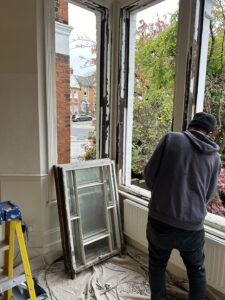
Condition of the box frame is the single biggest cost driver. A structurally sound box frame means the sashes can be removed, refurbished in a workshop, and reinstated — a straightforward process. Where the frame itself has widespread rot or failed structural integrity, the scope expands considerably and replacement may become the more economical option.
Window size and glazing specification also matter. Larger windows require more timber, more glass, and longer labour time. Upgrading to slimline double glazing adds £150–£300 per window over single-glazing refurbishment, but the thermal payback is real. Secondary glazing is a lower-cost alternative that suits listed properties where altering the original glass is restricted.
“If the box frame is structurally sound, significant rot is often repairable via timber splicing, making replacement unnecessary and preserving the heritage value of the original window.” — Axiom Eco Homes, 2026
Heritage and listed building status affects both the materials you are permitted to use and the labour involved. Conservation officers may require like-for-like timber species, specific glazing bar profiles, or traditional putty rather than modern sealants. This adds to both material costs and the time a skilled tradesperson needs on-site. Properties in conservation areas may not require formal listed building consent for repairs, but it is worth checking with your local planning authority before work begins.
Access and site logistics round out the main variables. Ground-floor windows are straightforward; upper-floor work may require scaffolding (typically £500–£1,500 for a standard scaffold on a two-storey terrace) or a cherry picker. Restricted parking, narrow access passages, and staircase limitations in flats all add time. Seasonal demand also plays a role — booking in autumn or winter, when tradespeople are less stretched, can occasionally secure a better rate.
Should you restore or replace your sash windows?
Restoration is usually the better choice where the box frame is structurally sound. Replacement makes sense when frames are beyond economical repair or when repeated interventions have failed to resolve the underlying problem.
Restore when:
- The box frame passes a structural survey with no widespread rot.
- Localised rot is confined to sashes, sills, or stiles — all repairable by timber splicing.
- The property is listed or in a conservation area and original fabric must be retained.
- Budget is a priority: refurbishment at £620–£920 per window versus replacement at £1,200–£3,500.
Replace when:
- The box frame has deep rot through the structural members and fails an integrity test.
- Repairs have been carried out repeatedly without lasting effect.
- The window is a non-original replacement already and there is no heritage case for retention.
- The overall cost of refurbishment approaches or exceeds replacement cost.
On energy performance, a well-refurbished sash with draught-proofing and slimline double glazing can achieve a U-value of around 1.8–2.0 W/m²K, compared with approximately 4.8 W/m²K for a single-glazed original. A modern uPVC replacement typically reaches 1.4–1.6 W/m²K. The gap is real but narrower than many homeowners expect, and replacement does not automatically save money once the full cost of new units, decoration, and disruption is factored in.
Original heartwood timber, used in Victorian and Edwardian sashes, is denser and more durable than modern fast-grown timber. Once replaced, that material is gone permanently — a consideration that carries real weight for period homes.
How long does refurbishment take, and how disruptive is it?
Minor repairs — a broken sash cord, a failed pulley, or a re-putty — are typically completed in a few hours per window. There is minimal disruption: the tradesperson works on-site, the window is operational again the same day, and no specialist equipment is needed.

Full refurbishment is a different process. Sashes are removed and taken to a workshop for timber splicing, stripping, priming, and repainting. Reassembly, draught-proofing, and hardware fitting then happen on-site. This typically takes one to three days per window, though batching several sashes in a single workshop run reduces the overall programme. A whole-house refurbishment on a Victorian terrace with six to eight windows might run one to two weeks on-site across multiple visits.
Listed building consent or conservation area approvals can add several weeks to the programme before work even starts. Bespoke joinery for replacement sashes carries its own lead time, usually two to four weeks from order.
A few practical steps keep disruption manageable. Working room-by-room rather than across the whole house at once means you always have a habitable space. Temporary draught covers or polythene sheeting protect the opening overnight when sashes are in the workshop. Staggering the schedule so external painting is done in dry weather avoids costly rework.
How to get accurate quotes and what to look for
Ask for an itemised written quote that separates labour, materials, glazing, scaffolding, and disposal fees. A single lump-sum figure makes it impossible to compare quotes fairly or understand what you are actually paying for.
A reliable quote should include:
- Scope of work — a window-by-window description of what will be done (cord replacement, sill splice, draught-proofing, reglaze, and so on).
- Parts list — timber species, glazing specification, hardware type, and paint system.
- Workshop vs on-site split — which elements are done off-site and which on-site, and who carries out the workshop work.
- Lead time — when work starts and the expected completion date.
- Warranty or guarantee — minimum one year on labour; longer on materials and glazing units.
- VAT treatment — whether the quoted price is inclusive or exclusive of VAT, and the applicable rate.
Red flags to watch for: a tradesperson who quotes without visiting the property; a scope described only as “sash window repair” with no itemisation; a price significantly below all other quotes without explanation; no references or portfolio of completed work.
Pro Tip: Ask specifically whether the contractor takes sashes to a workshop or works entirely on-site. Workshop-based restoration typically delivers better results for complex timber splicing and paint finishes — it is worth paying a modest premium for it.
Why professional refurbishment delivers better long-term results
Professional refurbishment preserves original timber and, when draught-proofing and slimline double glazing are included, delivers competitive thermal performance at a fraction of the cost of full replacement.
Integrated draught-proofing can reduce air infiltration by up to 50% and save approximately £20–£50 per window per year on heating bills. Across a six-window Victorian terrace, that represents a meaningful annual saving and a payback period well within the expected lifespan of the refurbishment work.
Historic England and the Energy Saving Trust both recognise targeted draught-proofing and secondary glazing as cost-effective measures for period properties, particularly where double glazing is restricted by conservation requirements. Including these measures in your quote from the outset, rather than adding them later, avoids a second mobilisation cost.
Workshop-based timber splicing matters because the quality of a splice depends on controlled conditions, proper clamping, and a full paint system applied in sequence. On-site repairs in variable weather rarely match the durability of shop-finished work. Original heartwood timber, once properly repaired and protected, can outlast modern fast-grown timber by decades — which is why preserving it is worth the effort.
VAT relief on listed building works is limited and subject to specific conditions. Verify the applicable rate with your local council and a qualified accountant before budgeting.
Key takeaways
Refurbishment is almost always the right starting point for period sash windows with sound box frames — it costs less, preserves original timber, and delivers real energy savings when draught-proofing is included.
| Point | Details |
|---|---|
| Refurbishment vs replacement cost | Refurbishment at £620–£920 per window is typically 40–60% cheaper than replacement at £1,200–£3,500. |
| London/South East premium | Expect prices to be moderately higher than national averages in London and the South East. |
| Draught-proofing payback | Draught-proofing saves approximately £20–£50 per window per year and cuts air infiltration by up to 50%. |
| Box frame is the key decision point | A structurally sound box frame means refurbishment is viable; widespread frame rot is the main case for replacement. |
| Sesashwindowrepair | Sesashwindowrepair offers surveys, itemised quotes, and workshop refurbishment across South East London. |
Why we recommend refurbishment for most South East London period homes
Our view is straightforward: where the box frame is sound, refurbishment is almost always the right call. We see this consistently across South East London, where Victorian and Edwardian terraces make up a large share of the housing stock. The original timber in these windows is genuinely superior material — dense, slow-grown heartwood that, once properly repaired and finished, will outlast a modern replacement sash by a considerable margin.
Our approach starts with an on-site survey. We assess the box frame, check each sash for rot and glazing condition, and give you a clear picture of what is repairable and what is not before any work is quoted. Sashes that need timber splicing or a full strip-back and repaint go to our workshop; simpler repairs are completed on-site. That split is deliberate — workshop conditions produce a better result for complex work, and we are not prepared to compromise on finish quality.
[Author credentials and case studies to be added here.]
[Client testimonials and proof points to be added here.]
Our before-and-after gallery shows the kind of results this approach delivers across a range of South East London properties.
Sesashwindowrepair: get a survey and itemised quote
Timber Sash Window Repair offers a practical alternative to the guesswork of online estimates. We carry out a proper on-site survey, give you a fully itemised written quote, and handle everything from workshop timber splicing to final draught-proofing installation.
Our services cover sash window refurbishments, sash cord repair, sill replacement, draught-proofing, replacement sash manufacture, and slimline double-glazing retrofits — all carried out by skilled timber specialists across South East London. Every job comes with a written guarantee on labour and materials, so you know exactly what you are getting before we start.
To request a survey or get a quote, contact us here. We will assess your windows, explain what work is needed, and give you a clear, comparable price with no surprises.
Useful sources and further reading
- Historic England — authoritative guidance on repairing and maintaining traditional windows in listed buildings and conservation areas, including approved materials and methods.
- Energy Saving Trust — practical advice on draught-proofing, secondary glazing, and the energy performance of period windows, with cost and saving estimates.
- Checkatrade sash window refurbishment cost guide — regularly updated UK cost data with average figures for common repair and refurbishment tasks.
- BestBuilders sash window cost guide — detailed 2026 price breakdowns covering repair, overhaul, draught-proofing, and replacement, including regional variation notes.
- Sesashwindowrepair service pages — details on survey, refurbishment, and repair services available across South East London, with contact information for booking.